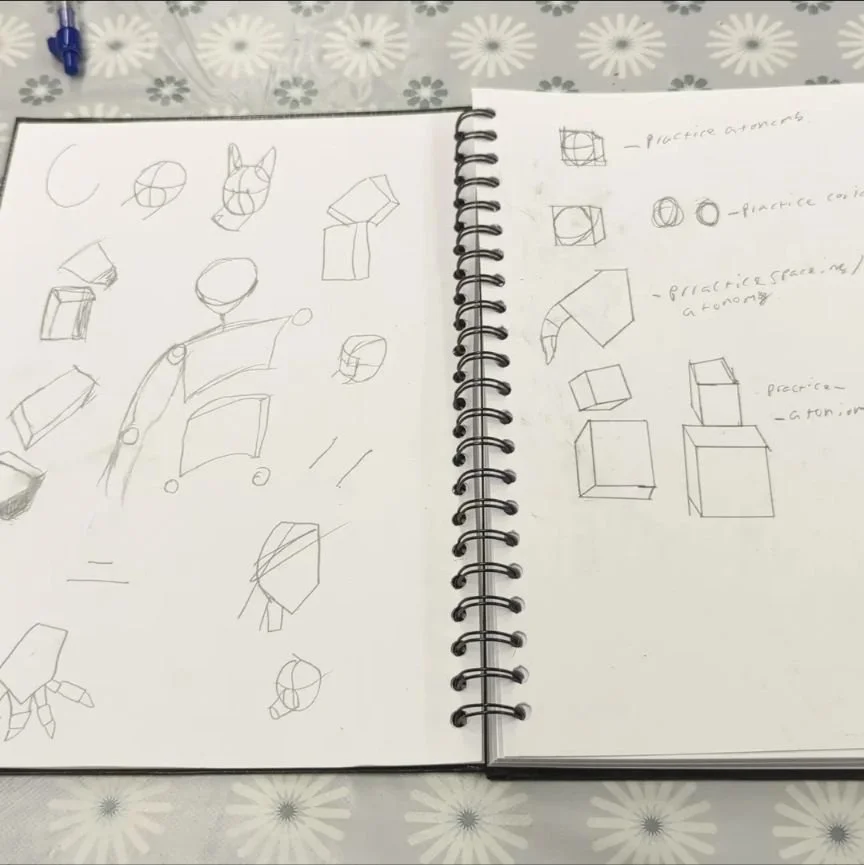
This page highlights the projects I’m actively working on right now a mix of in-progress pieces, experiments, and areas I’m focusing on improving. From early sketches and rough concepts to developing illustrations and worldbuilding studies, this section gives a look into my artistic process as it’s happening.

These works show what I’m exploring, what I’m refining, and what skills I’m currently pushing forward. It’s a space where ideas are still taking shape, and where I can track my growth in real time.

Thank you for taking a look at my ongoing work. I hope you enjoy seeing the creative journey behind the finished pieces.

What I need to Work on:
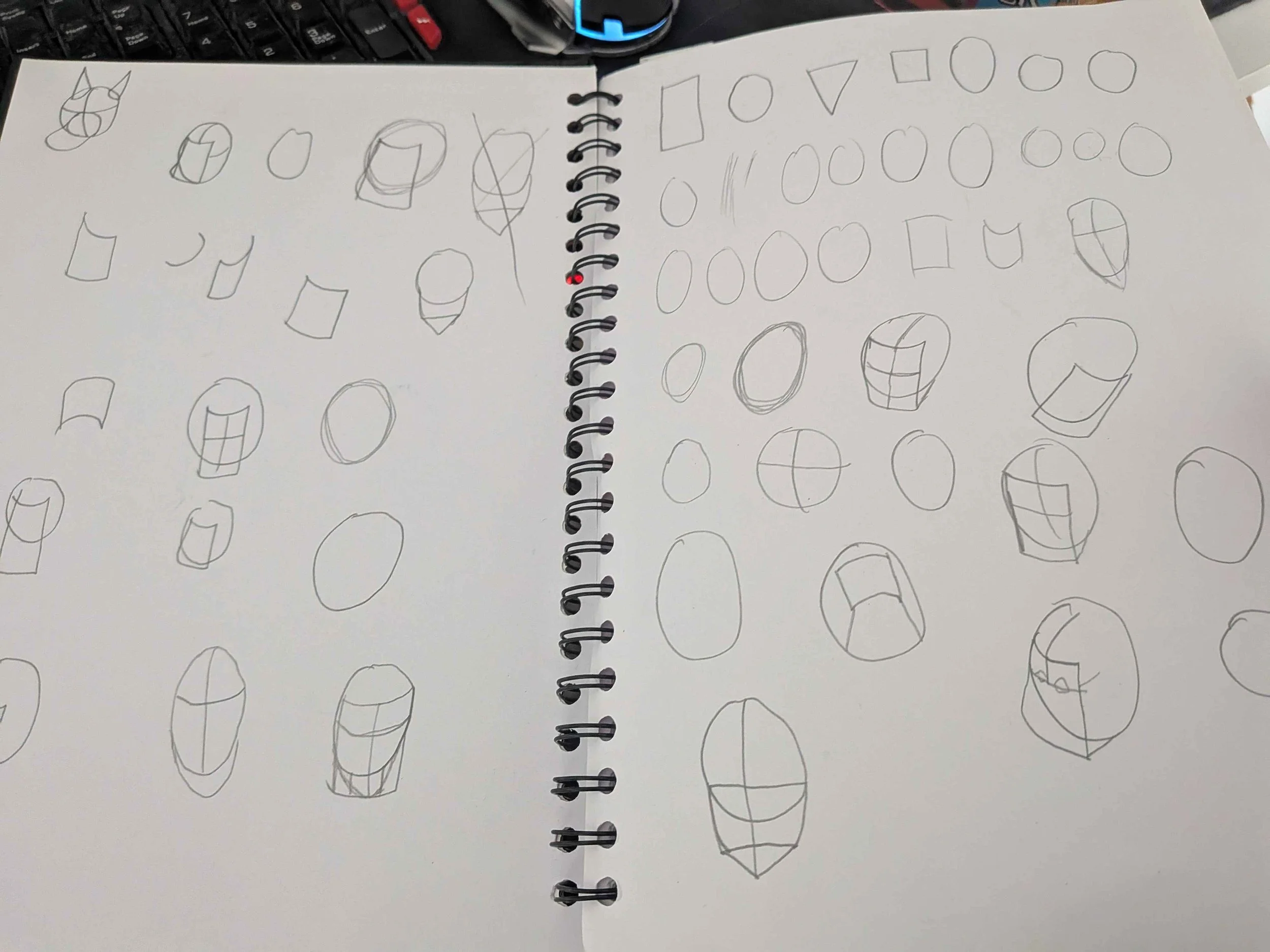
These pieces are part of my most recent practice work, focused on improving my understanding of faces, bodies, and overall construction. Each page includes exercises that help me identify what I need to strengthen including proportions, shape language, colour awareness, perspective, and anatomy.

It’s a mix of doodles, structural studies, and character-building practice, created to help me grow more confident and intentional in my designs. I’m steadily improving, and each page is another step toward developing stronger, more expressive artwork.

Group Project (Game Idea):

This concept art was created for a college group project centred around the theme “space.”
The team consisted of four members: one modeller, two coders, and myself as the sole artist. My role was to develop concept art that would establish a clear visual direction for the project and support the modelling and development process.

The game concept begins inside a rocket travelling through space, where the player can interact with menus, mission notes, and external views to create a more immersive alternative to a traditional title screen. The journey is advanced by entering a cryosleep tube. Once landed, the player undertakes a search-and-rescue mission to locate and repair a malfunctioning rover, with limited information due to a lost video feed.

Throughout the game, protective drones have become hostile after their AI is compromised. The player initially struggles to disable them, but later learns how to reset the drones through guidance from Mission Control. Gameplay focuses on navigating hostile environments, disabling drones, and ultimately confronting a rogue rover boss. The story concludes with multiple possible endings based on player choices, including failure states and successful completion.

My responsibility within the project was to create visual concepts for key elements such as drones, rovers, environments, and potential companions. These designs were intended to guide the modeller rather than act as final assets. I worked closely with the modelling team, particularly through regular discussion and iteration, to ensure the designs were practical, cohesive, and aligned with the gameplay and narrative goals of the project.

Despite time constraints limiting the overall scope of the game, this project demonstrates my ability to develop concept art within a collaborative environment, communicate ideas effectively across disciplines, and adapt my artistic style to suit a sci-fi setting.

These are two of the drone designs I have come up with so far, both of which are still in progress. As seen in the first design (left), I started from an angled view, which made creating other points of view difficult because I couldn’t consistently follow the design around the form.

This issue was addressed in the second design (right), which is still being worked on at the time of writing. I created this design by starting with four identical circles (the same size, positioning, and proportions) and beginning with a full front view. This approach allows me to better visualise and draw other points of view (side, top, and bottom) more accurately in relation to the front design.

Once the design is fully drawn, I will move on to colour, which will be discussed with other members of my team primarily Dylan, who is the team’s modeller. After the colour palette is decided, I will begin colouring the design.

I am also currently working on animal and rover concept art; however, due to the importance of the drones to the story of our game, I have prioritised completing the drone designs first.

This is my third rover concept design, developed with a strong moon-rover, combat-focused approach. Unfortunately, I did not document the design process and only retained the final piece. If I were to revisit this concept, I would ensure the process is fully documented through progress screenshots or iterations.

Overall, I am very pleased with how this concept turned out. It blends a moon-buggy–inspired structure with elements of fantasy and sci-fi combat, such as turrets and weapon systems. While the design includes a range of detailed elements, there are areas where further refinement could be made, particularly on the weapon, the main body, and potentially the tracks.

This is the finished piece of concept art for the drone, including a colour scheme to give the modeller on my team an indication of the types of colours I am suggesting. As is the nature of concept art, this piece is intended to provide ideas and visual guidance only and is not a final or complete design that the modeller will directly use.

To ensure I had enough time to create rough concepts for all required assets, I chose to leave the full colouring stage until the end of the project. This is something I am excited to return to, as it will allow me to further practise and improve my colouring, shading, and blending skills.

Overall, I think this piece turned out very well, especially considering that I am not usually accustomed to drawing this type of subject. I typically focus on fantasy-based projects rather than drones or sci-fi environments. Because of this, I found the process to be a valuable opportunity to expand my skill set and establish a baseline from which I can track my improvement in sci-fi concept art over time.

That being said, there are areas that could be improved. The perspective could be refined further; however, this was my first attempt at drawing the same object from multiple viewpoints, and for a first attempt I believe it was successful. Another area for improvement would be fully colouring the piece. While I plan to return to this once the remaining concepts are complete, time constraints meant this stage had to be postponed.

This is the start of my companion concept art. The main reference and inspiration for this design comes from the droid companion in Star Wars Jedi: Fallen Order. This idea was suggested by Dylan, and I liked the direction, which is why I chose to use it as a reference.

At this stage, I have only completed one leg, which will act as the starting point for the overall design. Ideally, for this concept art, I want to continue working on perspective while maintaining the same point of view, gradually building up the full form.

As I progress, I plan to add more detail, such as internal lines and mechanical separations within the robotic components, some of which can already be seen in the leg. This piece also continues my practice with sci-fi–themed artwork, particularly robotic designs.

This is the second stage of my companion concept art, where I developed the design by attaching the body to the leg. I am pleased with how this stage turned out, particularly given my level of experience working within this genre.

To further refine the concept, I plan to add the second leg and introduce additional smaller details to the body. These adjustments will help add depth to the design and make it clearer and more effective as a visual guideline for the team’s modeller during the development process.

This is the final design for the companion concept art. The design was refined by following earlier self-identified improvements, including the completion of the second leg to balance the form. A colour scheme was also introduced to convey a more friendly and positive tone, intentionally contrasting with the darker, more hostile visual language used in the drone designs.

This piece serves as the base design for one or more rover concepts. I intend to use it as the foundation for multiple variations with different functions. The spider-like structure provides a strong visual identity that helps evoke a sense of unease for the player, while also offering the modeller a distinctive and flexible design direction to develop further.

This is the second stage of one of my rover concepts, developed using the spider-like leg structure as a base. The design direction for this iteration focused on creating a more damage-oriented, attacker-style rover, which led to a stronger emphasis on combat-focused elements.

This piece was later refined into the final concept for the first rover design. The combat-oriented approach is reinforced through the addition of an EMP pulse turret mounted on the top of the rover. Additional surface details were included to provide the modeller with creative guidance and flexibility when translating the concept into a final in-game model.

This is the concept for a second rover design, focused on functioning as a drone-spawning unit rather than a direct combat platform, in contrast to the previous rover concept. Future improvements to this design would include adding additional surface detail and developing a cohesive colour scheme, both for this rover and the earlier combat-focused design.

These are the final concepts for my first two rover designs, accompanied by an initial colour scheme. As my first attempts at designing rovers, I feel they were successful overall; however, there are still areas for improvement, particularly in surface detail and colour application. When developing the colour scheme, I encountered similar challenges to those faced during my earlier drone concept, highlighting areas for further refinement and practice.

This is an early logo concept that I was assigned to create. Logo design and typographic work are both new areas for me, whether that involves drawing lettering or designing a logo as a whole. Because of this, I approached the task as an opportunity to experiment and learn.

This piece was also a fun chance to practise using blur effects, which can be seen in the background. The “RR” represents the name of the game, Rogue Rover. I also used this concept to practise outlining techniques, which I found particularly enjoyable. While I still need more practice with these techniques, the process itself was engaging and helped me develop confidence in an unfamiliar area of design.

Previous
Previous

Magic Circles (System)